Showing posts with label engineer. Show all posts

Monday, February 3, 2025

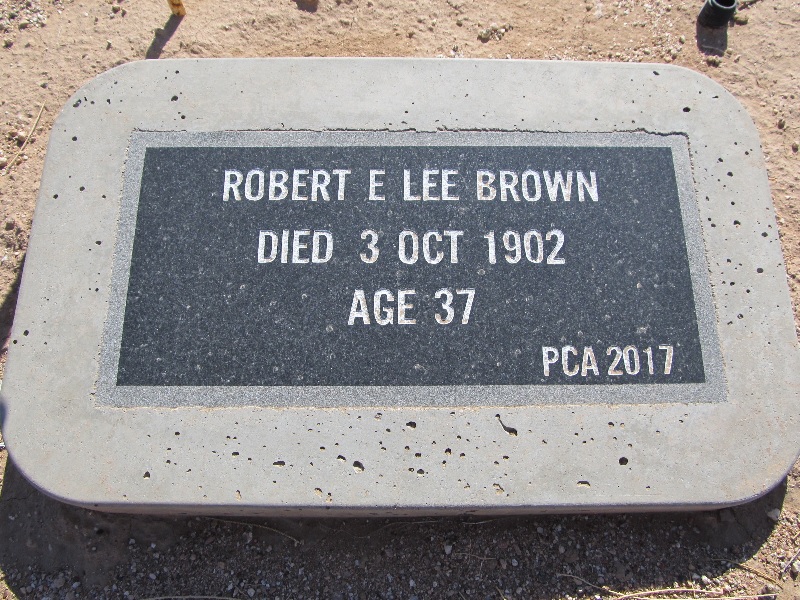
Robert E. Lee Brown (1865-1902) - Mining Engineer and Adventurer


PCA Archives

R. E. L. Brown may be one of the most unique characters in the Pioneer & Military Memorial Park, both for his colorful life--and the speed with which he was forgotten after his demise.

Born May 31, 1865, in Philadelphia, Pennsylvania, to Laurence and Martha Brown, he trained as a mining engineer, then went out west to locate promising mines.

In 1889, Brown was surveying potential mining claims in Washington state. During a violent labor strike in Coeur d’Alene, Idaho, in 1892, he started a newspaper called The Barbarian, which took the side of the mine owners versus the unionized miners.  This earned him the nickname “Barbarian Brown”.  Threatened with death during the strike, he caused a cannon to be wheeled into the street outside his office.

Much as he enjoyed the furor his newspaper editorials provoked, Brown remained first and foremost a mining engineer.  He speculated in mines and was well regarded internationally for his expertise.  Seeking new adventures, Brown journeyed to South Africa in hopes of securing some promising claims during a land rush in Witfontein in 1895. Competition was fierce for the best claims, but Brown hit upon a method that could outrun the swiftest horse:  a heliograph!  He set up heliograph stations by which he could transmit confirmation almost instantaneously to his confederates in the field who were waiting to stake his claims. 

On July 19, 1895, the day of the land rush, twelve thousand miners were gathered in Doornkoop to register their permits.  But Brown had devised a plan to ensure that he would be first in line.  A fan of American football, he recruited a group of rough men from local bars to form a “flying wedge” to cut through the crowd.  The ruse worked; however, the Pretoria government initially refused to honor his claims.  Brown sued the Boer government and eventually won a huge judgment, the exact value of which has never been ascertained.

Having worn out his welcome in South Africa, the brash engineer returned to North America where, on September 26, 1898, he wed Maud Higgins in Victoria, British Columbia. 

Brown was in London in 1901 when he apparently contracted tuberculosis.  In late 1902, he traveled to Phoenix in a private train car with his wife, his personal physician and a nurse.  Unfortunately, he had left it too late; he died on October 3, 1902, scarcely a week after his arrival.   Despite his fame and fortune, his death rated only a few lines in the local newspaper, and he was buried under a simple wooden headboard in Rosedale Cemetery.  

One can only speculate as to why Brown’s remains were not shipped back East and why a more elaborate headstone was never erected over his grave.

- 
 -  
by Donna L. Carr


Tuesday, June 18, 2024

John McCasey (1819-1895) - Civil War Vet and Mining Engineer

PCA Archives

John McCasey was born between 1819 and 1825 in Ireland.  At some point, he immigrated to the United States and settled in Luzerne County, Pennsylvania.  He seems to have had a rather good education, enabling him to work as a machinist, mining engineer and metallurgist throughout his life.

At the outbreak of the Civil War, McCasey enlisted as a private in Company E, 8th Pennsylvania Infantry, on April 18, 1861.  He and Cornelia Connolly were married before a priest on June 4, 1861, in Scranton, Pennsylvania. 

McCasey was soon promoted to the rank of captain in Company K, 110th Pennsylvania Infantry.  However, he resigned his commission on July 29, 1861, stating that ill health made him unfit to perform his duties.  He returned home to recuperate, where his and Cornelia’s first child, William Francis, was born on August 12 of the following year.

McCasey reenlisted briefly on July 1, 1863, in Company B, 41st Pennsylvania Emergency Militia, an ad hoc unit raised to defend the state from the Confederate advance toward Gettysburg.  He was discharged on August 3, 1863.

Following the Civil War, McCasey found work as a machinist.  He and Cornelia, or Lillie as she was called, had eight children, although only four lived to adulthood.

The 1880 federal census of Jersey City, New Jersey, lists McCasey as a ‘silver miner’.  Shortly after his oldest son turned 21, McCasey moved to Arizona, while his wife Cornelia remained in Pennsylvania to raise the rest of their children.

McCasey found work as a mining engineer in the vicinity of the Harqua Hala Mine near Yuma.  In 1889, he wrote a detailed description of the ores and other minerals to be found there.  In 1891, he discovered a significant onyx deposit north of Cave Creek, Arizona.

John McCasey moved to Mesa, Arizona, and set up an assay office there in 1893.  After transferring his GAR membership to the John Wren Owen GAR Post, he filed for and received Invalid Pension #865,681. He seems to have lost touch with his friends back East, as his whereabouts were not known until one of his old Army companions tracked him down through the GAR.

McCasey died February 23, 1895, having been hospitalized for about three months with pulmonary tuberculosis.  He was buried in Porter Cemetery.

His widow Cornelia filed for and received a Civil War Widow’s pension, # 471,053.  She was living in the Bronx, New York City, when she died on June 29, 1919.

-Donna Carr


Monday, June 3, 2024

Robert E. Lee Brown (1865-1902) - Mining Engineer and Adventurer

PCA Archives

R. E. L. Brown may be one of the most unique characters in the Pioneer & Military Memorial Park, both for his colorful life--and the speed with which he was forgotten after his demise.

Born May 31, 1865, in Philadelphia, Pennsylvania, to Laurence and Martha Brown, he trained as a mining engineer, then went out west to locate promising mines.

In 1889, Brown was surveying potential mining claims in Washington state. During a violent labor strike in Coeur d’Alene, Idaho, in 1892, he started a newspaper called The Barbarian, which took the side of the mine owners versus the unionized miners.  This earned him the nickname “Barbarian Brown”.  Threatened with death during the strike, he caused a cannon to be wheeled into the street outside his office.

Much as he enjoyed the furor his newspaper editorials provoked, Brown remained first and foremost a mining engineer.  He speculated in mines and was well regarded internationally for his expertise.  Seeking new adventures, Brown journeyed to South Africa in hopes of securing some promising claims during a land rush in Witfontein in 1895. Competition was fierce for the best claims, but Brown hit upon a method that could outrun the swiftest horse:  a heliograph!  He set up heliograph stations by which he could transmit confirmation almost instantaneously to his confederates in the field who were waiting to stake his claims.

On July 19, 1895, the day of the land rush, twelve thousand miners were gathered in Doornkoop to register their permits.  But Brown had devised a plan to ensure that he would be first in line.  A fan of American football, he recruited a group of rough men from local bars to form a “flying wedge” to cut through the crowd.  The ruse worked;  however, the Pretoria government initially refused to honor his claims.  Brown sued the Boer government and eventually won a huge judgment, the exact value of which has never been ascertained.

Having worn out his welcome in South Africa, the brash engineer returned to North America where, on September 26, 1898, he wed Maud Higgins in Victoria, British Columbia. 

Brown was in London in 1901 when he apparently contracted tuberculosis.  In late 1902, he traveled to Phoenix in a private train car with his wife, his personal physician and a nurse.  Unfortunately, he had left it too late; he died on October 3, 1902, scarcely a week after his arrival.   Despite his fame and fortune, his death rated only a few lines in the local newspaper, and he was buried under a simple wooden headboard in Rosedale Cemetery.  

One can only speculate as to why Brown’s remains were not shipped back East and why a more elaborate headstone was never erected over his grave.

-Donna Carr


Tuesday, December 19, 2023

#12 - Thomas Hayden (1880-1940) - Engineer


PCA Archive

Thomas Hayden was born June 2, 1880, in Nova Scotia, Canada, to Thomas Hayden and Elmyra Ringer. Young Thomas studied civil engineering at Yale and, in 1908, came west to work on a dam in New Mexico. He was in Phoenix by the outbreak of World War I, during which he served. After the war, he returned to Phoenix where he became a surveyor and engineer for the Salt River Valley Water Users Association. Walking home from his office near the State Capitol, he often passed by a neglected pioneer cemetery. Intrigued, he surveyed the graves in 1937 and helped found the Pioneer’s Cemetery Association to preserve the site. Following Hayden’s unexpected death on December 23, 1940, his ashes sat unclaimed at the mortuary for 48 years. In 1988, they were finally interred on the south side of the Avenue of Flags in the cemetery he had helped to save.