Showing posts with label 1905. Show all posts

Friday, July 18, 2025

George Frank Breninger (1865-1905) - Naturalist


Masons Cemetery with Masonic Memorial - PCA Archives


George Frank Breninger was born September, 1865, probably in Philadelphia, Pennsylvania.  From age fifteen, he manifested an intense fascination with nature, collecting specimens, pelts and eggs.  His collection of birds’ eggs was at one time considered the fourth largest in the country.

Breninger became an ornithologist and expert taxidermist, mounting many of his specimens himself.  As a naturalist, he had traveled widely in the continental United States from the Rockies as far south as the Isthmus of Panama to locate and collect rare species.  Some of his work was sent to the Smithsonian Museum and Field Columbian Museum in Chicago.  Another of his collections was at Colorado State University. 

He married Margaret J. Hoag, daughter of Addison Hoag in Fort Collins, Colorado, on September 19, 1888.  Although he and his wife had five children, only their oldest son, David Addison, had a somewhat normal lifespan.  Juvenile diabetes seems to have run in the family, as son Walter and daughter May both died of it before insulin became available to treat it.  Another child died in infancy, and daughter Luella Ruth died of scarlet fever in 1903.

The family moved to Phoenix around 1897.  In 1900, Professor Breninger spent six months in the Rockies, collecting specimens for the Foote Mineral Museum in Philadelphia.  He published several scholarly papers about birds.

In 1903, Professor Breninger traveled to Guatemala and Nicaragua for four months to secure 500 bird specimens for the Field Columbian Museum.   The conditions of the trip were rather primitive and Breninger’s team was regarded with some suspicion by the locals, who feared they might be a filibustering expedition intent on destabilizing the Mexican government.  Breninger collected many parrot specimens and even some ocelots.  He also brought back an orchid plant.  It survived the six-week journey back to Arizona and bloomed in 1904.

Breninger grew different varieties of crops on his farm to determine whether they could survive in desert conditions.  His wife Margaret had a fine flower garden and sold cut flowers in season.  It is not known whether they had a greenhouse for their more delicate plants, although there were greenhouses in Phoenix by 1913.

For years, Breninger was exposed to arsenic in the course of his taxidermy work.  Although he knew it was detrimental to his health, such was his devotion to his nature studies that he accepted the risk.  He suffered three strokes, with each one leaving him weaker. 

He died on December 2, 1905, at his home at 386 North Sixth Avenue.  After a Christian Science funeral, he was buried in Masons Cemetery. 

-by Donna Carr


Generated with AI Bing Image Creator


Friday, July 11, 2025

Robert John “Robin” Icke (1858-1905) - Ostrich Wrangler

Microsoft Stock Image


Robert John “Robin” Icke was born April 1858 in Attleborough, Warwickshire, England. He married Fannie Townsend in England.  However, their first child, John Henry Townsend Icke, was born April 1888 in Bathurst, Eastern Cape, South Africa, where Mr. Icke had gone to engage in ostrich farming.  Ostrich feathers were in great demand for Victorian ladies’ millinery, and the huge birds were also raised for their meat.

The couple’s second child, Edith Winifred Icke, was born in July 1890 in Wellington, Shropshire, England.  The 1891 census of England and Wales also recorded the Ickes in Wellington, where Mr. Icke was working as a commissions agent.

By about 1893, the Ickes were in Minneapolis, Minnesota, when Mr. Icke was hired by Josiah T. Harbert to manage his ostrich farm in south Phoenix.  Perhaps the desert climate reminded the Ickes of South Africa, for they came to Arizona at once…and stayed.  The United States federal census of 1900 records them living about three miles northwest of Phoenix.

Around this time, newspaper accounts suggest that Robin Icke was of unsound mind.  He was committed to the insane asylum for a brief period in September of 1900. In April 1901, Fannie Icke contracted typhoid fever.  She died on April 13th.   Because Mrs. Icke’s doctor had been sanguine about her chances of recovery, and because of her husband’s previous mental illness, an autopsy was ordered.  It proved, however, that Mrs. Icke had indeed died of typhoid fever.

Fannie Icke was buried in Porter Cemetery, Block 17.  Shortly thereafter, the two Icke children--John, 13, and Edith, 10—were sent back to England to be raised by Fannie’s married sister.

While the exact nature of Robert Icke’s mental illness is not known, the death of his wife and the loss of his children may well have pushed him over the edge.  On March 2, 1905, he died of alcoholism in his room at the Commercial Hotel in Phoenix.  He was buried next to his deceased wife in Porter Cemetery, B17.

- by Donna Carr


Monday, January 20, 2025

Edward J. Lowry (1855-1905) - Sheriff in Ferry County, Washington


Generated AI

Edward J. Lowry was born in 1855 in Carbon Township, Huntingdon County, Pennsylvania.  He was the son of Irish immigrants Michael Lowry and Bridget Conley. 

Huntingdon was coal-mining country, and Michael was miner.  He may also have been a member of the Molly Maguires, a secret society whose intent was to counter the exploitation and terrible working conditions of coal miners.  The Molly Maguires are sometimes considered a precursor to the labor unions of later decades.  If Michael was involved with the Molly Maguires, perhaps that was why the Lowry family left Pennsylvania for Saline County, Ohio.  By 1870, Edward, aged 15, was himself working in the coal mines there.

In 1877, Edward married Sarah Humphrey.  The young couple moved to Boulder, Colorado, where their first child, Edward, Jr., was born in 1879.  Edward continued to work as a miner, and he also became an organizer for a short-lived union, the Knights of Labor.

Something must have intervened in the late 1880s to set Edward on a different path.  Sarah was living temporarily with her parents in Bevier, Missouri, when the Lowrys’ second son, Ralph, was born on April 18, 1889.  A decade later, in 1900, the family had reunited in Republic, Washington, a sparsely populated region in the far West.  Edward and his older son were still working as coal miners until, in late 1900, Edward was elected sheriff of Ferry County.

Apparently, Edward was pretty good at his job.  The local newspapers printed detailed accounts of the sheriff’s activities, including the time when five prisoners sawed through the wooden ceiling of their cell and escaped via the roof on Christmas morning, 1901.  Hot on the trail of the fugitives, Sheriff Lowry caught up with two of them three days later, just as they were in the act of robbing the customers of a saloon!

January 1904 brought a case of a personal nature.  Sheriff Lowry’s wife Sarah, who had been suffering from an unspecified mental illness, escaped from the Mount View sanitarium in Spokane.  Fortunately, she was found the next day at a local hotel.

By 1905, Lowry was suffering from tuberculosis.   Seeking a warmer climate, he and his 16-year-old son Ralph set out by train for Phoenix, Arizona, arriving on October 9th.  Perhaps the long trip had exhausted Lowry’s strength, for he died the following day.  The Fraternal Order of Eagles arranged for his funeral and burial in Rosedale Cemetery.

Lowry’s son Ralph graduated from Washington State College in 1917 with a degree in civil engineering.  He was eventually employed as a senior engineer for the U. S. Bureau of Reclamation and worked on the Hoover Dam, the Shasta Dam and the Grand Coulee Dam.

-by Joseph P. Lowry


Monday, January 13, 2025

Noah Broadway (1831?-1905) - Maricopa County Sheriff


PCA Archives

Noah Broadway is believed to have been the son of William M.  Broadway and Mary “Polly” Key.  On the federal census of 1850, Broadway was living with his brother John in Kemper County, Mississippi, and his age was given as 19, making him born around 1831. 

No photo of Broadway has ever been found, nor evidence of him marrying or serving during the Civil War.  He seems to have been a somewhat solitary man.

Broadway is known to have been farming in the Salt River Valley by 1868.  He and seven other men formed the Prescott Ditch company on 26 Sep 1870, and dug the Prescott (later Broadway) Ditch to irrigate his crops.

The Maricopa Crossing was on Broadway’s ranch.  It was a nice crossing with a firm gravel bottom, and the stages usually crossed the Salt River there.  The road which ran through Broadway’s ranch is known today as Broadway Road.

Broadway never sought public office but was nominated for sheriff by Dr. W. W. Jones and elected on the 14th ballot in late 1884.  Although he was considered to be of good and honest character, some didn’t support him as he had publicly expressed a desire to ‘string up’ men who were selling whiskey to Indians. 

Broadway was the first sheriff to have his office in the new, two-story brick courthouse between First and Second Avenues facing Washington, the previous office being in an adobe structure.  The county jail was not very secure and security was lax; eight prisoners almost escaped one day when someone failed to lock up.

As sheriff, Broadway regularly conveyed prisoners to Yuma.   Another of Broadway’s duties was conveying insane people to the hospital in Stockton, California.  On 9 March 1885, the county approved the issuance of bonds to build an insane asylum in Phoenix. 

Broadway’s term as sheriff was plagued by a rash of armed robberies.   Men dressed as Indians held up stagecoaches carrying Wells Fargo boxes north of Phoenix.  Detective work led to the arrest of one John Pennington and two cohorts. The massacre of the Martin family in 1886, supposedly by the Valenzuela gang led by S. P. Stanton, also occurred during Broadway’s watch.

Water rights were a contentious issue in frontier Phoenix, for land was virtually worthless without it.  Broadway occasionally had to fight for his rights in court.  He owned the NW quarter of Section 30, Township 1N, Range #E.  He later acquired the NE quarter and the NE quarter of Section 25, Township 1N, Range 2E.  In time, Broadway and Michael Wormser became the two biggest landholders in south Phoenix.

By 1902 Broadway’s health was declining and his ranch was much neglected.  When he died in 1905, his lawyer sold the ranch and liquidated his assets, which amounted $12737.  Since Broadway had no other heirs, this sum was divided among his three surviving sisters.

-by Donna Carr


Wednesday, December 25, 2024

#1 Amos J. Dye (1847-1905) - Judge and Ohio State Legislator


PCA Archives

Amos J. Dye was born April 2, 1847, in Marietta, Ohio.  He was the son of Amos J. Dye, Sr., and Maria Taylor.  In 1860, the Dyes owned a large and valuable tobacco farm.

On 18 January 1864, at the age of eighteen, Amos enlisted in the Union army and was assigned to Company H, 77th Ohio Volunteer Infantry.  Just a few weeks thereafter, he married Marinda Jane McCowan on February 11, 1864. 

On January 1, 1865, he transferred to Company D, 77th Ohio Volunteer Infantry.  He was discharged March 8, 1866 in Brownsville, Texas, with the rank of private.  Possibly his unit went there after the Civil War as part of the Reconstruction effort.

Amos Dye and Marinda had a son, Herbert, in 1867, and a daughter, Ida, in 1868.   He was admitted to the Ohio bar as a lawyer in 1877.  By 1880, the Dyes were living in Huntington, West Virginia, where Amos was practicing law.

Marinda died of stomach cancer in May, 1894, in Cincinnati, Ohio, where she had been active in a fraternal society called the Knights and Ladies of Honor.  Amos Dye himself was by then a Mason, and a Republican state legislator.  Soon, he became an attorney for the Ohio State Dairy and Food Department.

Dye married Ida Selma Schaetzle, a divorcee, on December 12, 1895.  A son named Amos was born in 1897 and a daughter, Selma, in 1901.   Another son, Stelman, seems to have died in infancy.

In 1896, Amos Dye was accused of accepting a $5000 bribe from a representative of the Paskola Company on condition that the state would not prosecute a case against the company.  Dye vigorously denied taking a bribe and countersued.  Apparently he did not lose his state position since he continued to handle cases.

Tiring of Ohio winters, Dye purchased the Rumney house on Grand Avenue in 1902 and thereafter, the Dyes spent their winters in Phoenix.  The Dye family was living a mile and a half north of Grand Avenue when Amos died on December 30, 1905, of cardiac insufficiency.  He was buried in the Masons Cemetery, Block 17, Lot 3, Grave 3.

Dye’s widow Ida was left to raise their two surviving children alone.  She filed for a widow’s pension on February 17, 1906, but her application was rejected on the grounds that Dye’s cause of death was not the result of his military service.  She did not remain alone for long, though.  Sometime in 1908, she married Peter William De Jong.  Ida lived until 1954.

-by Donna Carr


Saturday, December 7, 2024

#11 Reuben A. Hill (1839-1905) - Skilled Soldier, But Odd With Money


PCA Archives

Reuben A. Hill was born November 5, 1839, in  Naples, Cumberland County, Maine.  He was the son of John Hill and Rebecca Garland, farmers in the area.  Farming did not seem to be in Reuben’s future, however.  By 1860, he was already in San Francisco, California, working as a common laborer.

That changed with the outbreak of the Civil War, when Reuben Hill enlisted in the Union Army for a term of three years.  On September 29, 1861, he mustered in at Camp Downey, near Oakland, California, as a third corporal in Co. I, 1st California Infantry. 

As part of the California Column commanded by Colonel James H. Carleton, Hill’s unit was posted to the New Mexico Territory, where it saw action against the Confederates at Picacho Peak, Arizona.  Hill seems to have been an effective soldier.  He was promoted to sergeant and then commissioned a captain in Co. K, 1st New Mexico Volunteers (New), at Fort Sumner, New Mexico Territory, Feb. 29, 1864.  Captain Hill resigned at Fort Union, New Mexico Territory, on February 6, 1866. 

After the war, Hill returned to Maine where he married Vesta Marhon Whittier on January 19, 1865, presumably while on leave from his military duties.  They remained married until January 1880, when Reuben divorced Vesta so that he could marry a widow, Jane Tyler Burrell Wilson.

Jane later alleged that Hill drank excessively and was abusive.  By the time he moved out in 1894, he had spent all of Jane’s money.  Destitute, Jane was forced to move in with her married daughter.  Although Hill suggested that Jane divorce him, she did not do so—possibly because of the social stigma of being a divorced woman.

Reuben Hill then secured a loan from another widow, Olivia S. W. Payne, with which he purchased a hotel in Strafford, New Hampshire.  He remained in New Hampshire until about 1902, when he sold the hotel and moved to Arizona to speculate in mines.  Once in Phoenix, Hill was cagey about his past and intimated that he had traveled in Europe on a mission for the U. S. government’s secret service. 

On December 7, 1905, Reuben Hill died of a broken neck when thrown from his wagon near his mining property at Cave Creek, Arizona Territory.  He was buried in Rosedale Cemetery, North section,  Block 168, Grave 7.

Hill’s widow Jane did not learn of his death until her son-in-law saw a notice published in a Boston newspaper.  Since she was still legally married to Hill at the time of his death, she applied for and received a widow’s pension based on his Civil War service.

 -by the Pioneers’ Cemetery Association, Inc.


Monday, September 16, 2024

Magdalena Mendivil Donnelly (1830 - 1905) - Rancher’s Wife


PCA Archives

Maria Magdalena Mendivil was born sometime between 1832 and 1839 in Altar, Sonora, Mexico.  She came north around 1857 with three of her brothers.  While her brothers went on to Monterey, California, in search of work, Magdalena remained with family friends in Yuma.  By the time the brothers returned, however, they found that Magdalena had moved in with George Kippen, an agent for a mining company, who was about twenty years older than she.

To date, no record of an actual marriage has been found.  Very likely this was because George Kippen was already married to Jane A. Nichols of Fairfield County, Connecticut, by whom he had three children.   Sometime after the birth of the third child, George left Connecticut for good.  By 1852, he was working as a miner in California.

The 1860 federal census of Colorado, San Diego County, California, shows George Kippen and Madalena Maldives [sic] living there in the same household, although not married.  Their first son John was born 1860.  John was quickly followed by a daughter, Delfina.

Having had little success at mining, Kippen got a contract to haul supplies from California to the military outposts in Arizona.  He was at Camp McDowell, working as a sutler’s clerk and pharmacist, when he died suddenly on 22 February 1868 and was buried in the post cemetery.  Because Kippen was a civilian employee, his body was not transferred to the national cemetery in San Francisco when the post was decommissioned in 1891.  His headstone can still be seen today at Fort McDowell. 

With Kippen dead, Magdalena was hard-pressed to support her children.  By 1870 the family were living in the household of a Charles Foster in Arizona City, Yuma County, Arizona.  They appear on the 1870 federal census under the surname “Kippin”.

Around 1871, Magdalena met and married a wagonmaster, Frank “Owen” Donnelly, in Yuma, Arizona.  Donnelly, an Irish Catholic, had been born around 1837 in the village of Tyme, County Cork, Ireland.  Upon immigrating to the United States, he found few job opportunities for Irish immigrants.  So, on 21 June 1859, Donnelly enlisted as a private in Battery F, 2nd U. S. Artillery, at Fort Leavenworth, Kansas, and served until he was discharged on 2 May 1862.

Frank “Owen” Donnelly and Magdalena’s first child, Amelia was born 12 April 1872 in Yuma.  Isabelle “Lizzie” was born 7 April 1874, and Katherine “Kate” Inez was born 6 December 1878.  The Donnellys eventually moved to a ranch near Florence, on the San Pedro River.

By 1890, Frank Owen Donnelly was infirm and living in the Old Soldiers’ Home in Sawtelle, Los Angeles County, California.  He died there on 21 September 1894 and was buried in the National Cemetery in Los Angeles.  Magdalena received a widow’s pension based on his Civil War service.

On the 1900 federal census, Magdalena was recorded living in Pinal County, Arizona, on the Donnelly ranch with her son John Kippen, daughter Kate Donnelly, and granddaughter Elsie Harrington.  She died of pneumonia in Phoenix on 11 February 1905 and was buried in Rosedale Cemetery, Phoenix.

-by Donna


Monday, August 12, 2024

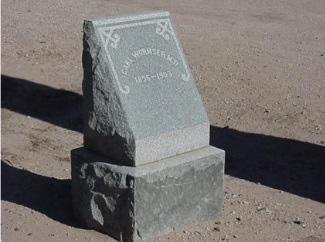
Dr. Carl Wormser (1856 - 1905) - A Trip for Naught


Dr. Wormser
 PCA Archives


Dr. Carl P. Wormser was born August 21, 1856, in Nijverdal, Overijse'll, the Netherlands. He was the son of Hendrik Wormser and M. Arends. He arrived in the United States September 9, 1874, whereupon he became a resident of Michigan. Although two of his half-brothers entered the ministry of the Dutch Reformed Church, Carl Wormser attended Columbia College’s School of Medicine, graduating with the class of 1878-1879. Following graduation, he returned to Michigan, where he married Helena Hoedemaker on March 8, 1881. Dr. Wormser then returned to New York to practice medicine.

Around 1883 he removed to Orange City, Iowa, and set up practice. There was a significant Dutch community in Orange City and other members of the Wormser family had come to the area several years prior to his arrival. Dr. Wormser’s practice proved prosperous, and he invested some of the proceeds in real estate.

Dr. Wormser was an avid fisherman and, like a true Dutchman, enjoyed being near water. In 1892, he and three other businessmen from Orange City pooled their resources to purchase a summer cottage on Miller’s Bay, where they and their families could vacation.

According to a local newspaper, by 1903 Dr. Wormser was suffering from Bright’s disease. Having disposed of his real estate holdings in Iowa, he hired a private rail car and left for Phoenix on November 25, 1903, in hopes that a warmer climate might prolong his life. The rental of the private rail car alone cost $1195. Because his condition was so grave, he was accompanied by his wife, his three daughters, and two of his colleagues, Dr. De Lespinasse and Professor Soulen. Unfortunately, the trip was for naught as Wormser died in Phoenix of asthma on December 24th. He was buried in Rosedale Cemetery.

His widow and daughters moved on to California, where Mrs. Helena Wormser died May 28, 1904. Her remains were returned to Phoenix for burial next to her husband.

By Patty G.

Monday, July 8, 2024

Samuel Calvin McElhaney (1861-1905) and Sarah Ella Hill McElhaney (1872-1911) - Pioneer Ranchers

McElhaneys
Taken from Headstone at the PMMP

Samuel Calvin McElhaney was born 9 October 1861 in Alabama.  As a young man, he drove a herd of cattle and horses from Texas to Phoenix and settled near the Salt River, with its assured supply of water. 

On January 10, 1889, McElhaney was among those who incorporated as the Fairmount Water Storage Company, for the purpose of selling water for irrigation and mining purposes in Maricopa County.  Another shareholder was Reuben Hill, soon to become his father-in-law.  Sam married Sarah Ella Hill, daughter of Reuben Hill and Mary Perry, on April 10, 1889. 

The newlyweds moved to Holbrook, where they enjoyed a few years of success before a severe drought forced ranchers to leave the high country.  The McElhaneys then drove their stock back down to the Salt River Valley and established a farm in the old Fowler district just south of Glendale, where Sam built a house for his growing family.  Son Randolph Hill Mc Elhaney was born in 15 July 1890.  He was soon followed by a daughter, Nina Inez, born 24 January 1892.

Sam McElhaney and George Keefer were obviously good friends, seeing as how Sam named his second son, born in 1894, Louis Keefer McElhaney.  That child died in January 1897.

More children followed.  Daughter Pearl was born 21 November 1898.  Another son, Coyt Ruben, was born about 1901.  Byron Samuel McElhaney was born 7 April 1903.

From an early age, Randolph was his father’s right-hand man.  On November 28, 1905, while loading some fat hogs into a wagon to be taken to market, Sam severely jammed his thumb, causing him agonizing pain.  Although he repeatedly assured his son that he was hurt in no place but the thumb, the pain was so unbearable that he fainted twice while attempting to walk the short distance to the house. He was dead, presumably of shock, by the time the doctor arrived.  Following the funeral at First Baptist Church, Sam McElhaney, aged 43, was buried in Loosley Cemetery.

This left Sam’s widow Ella and son Randolph to manage their farm.  Ella’s last child, Samuel Jr., was born posthumously in 1906.  When she died on 18 March 1911, she too was buried in the family plot in Loosley. 

Both Randolph and Samuel Jr. went on establish large ranches of their own in the 1930s.  Randolph settled in Chino Valley and Samuel founded the McElhaney Cattle Company of Wellton, Arizona, which remained under family control until 2010.

-Debe Branning and Donna Carr


Friday, June 14, 2024

Honoring Valor: The Restoration of a Veteran's Grave Site


PCA Archives

Amer DeShane McGinnis was born around 1849 to John and Laura McGinnis.  He enlisted in the military in 1867 when he was a farmer at 21 1/2 years old, and participated in the Indian Wars, as a soldier in Company A, 32nd United States Infantry. He was discharged June 28, 1870.  He married Annie Pickering, the widow of William L. Pickering on November 27, 1890 at Vulture City, Arizona. William had died in Vulture City. He was the owner of a saloon there. Unfortunately, Annie died on July 23, 1891.

Later, Amer would be appointed as a U.S. Postmaster at Calderwood, Maricopa, Arizona on January 26, 1892. Amer died on November 8, 1905, and is buried next to his wife Annie in City Loosley. 

-Val


Recently, we were honored to have volunteers from the Travis Manion Foundation help with placement of a military marker for Amer McGinnis and a weed cleanup in our cemetery. The new marker was a replacement for the old one that had weathered to the point where the Amer's name was no longer visible. Veterans of the group joined together to place the marker, which weighs 220 pounds.  The mission of the TMF is to empower veterans and families of fallen heroes to develop character in future generations.  Thank you all.

-Patty


Tuesday, December 12, 2023

#7 - Maude G. Seip (1871 - 1905) - Phoenix Socialite


Photo by Denise

Maude G. Seip was born on April 4, 1871 in Kansas.  She married Sam N. Seip around 1891, who was a notable cigar manufacturer in the city of Phoenix, and an admirer of the inventions of Orville Wright. Sam was also a well known and successful volunteer firefighter with the Pioneer Hose Company 1 in Phoenix AZ.  They had two children both of whom died in childhood and are buried at the PMMP.  

Maude was a known socialite who often gave garden parties and luncheons at their prominent home located at 373 N 1st Avenue in Phoenix.  In 1893, on a tour of the east, Maude and her husband were dragged from their sleeping car on a train in Texas, and told they were being arrested for murder.  After a telegram arrived to the police providing a more accurate description of the actual perpetrators, they were set free. 

 Maude died on December 25, 1905 of acute yellow atrophy of the liver, and is buried in the Knights of Pythias Cemetery. -Donna C.

Monday, March 22, 2021

Noah Broadway (1833 - 1905) - Arizona Lawman


PCA Archives - Noah Broadway

Noah Broadway is believed to have been the son of William M.  Broadway and Mary “Polly” Key.  On the federal census of 1850, Broadway was living with his brother John in Kemper County, Mississippi, and his age was given as 19, making him born around 1831.   

No photo of Broadway has ever been found, nor evidence of him marrying or serving during the Civil War.  He seems to have been a somewhat solitary man. 

Broadway is known to have been farming in the Salt River Valley by 1868.  He and seven other men formed the Prescott Ditch company on 26 Sep 1870, and dug the Prescott (later Broadway) Ditch to irrigate his crops. 

The Maricopa Crossing was on Broadway’s ranch.  It was a nice crossing with a firm gravel bottom, and the stages usually crossed the Salt River there.  The road which ran through Broadway’s ranch is known today as Broadway Road. 

Broadway never sought public office but was nominated for sheriff and elected on the 14th ballot in late 1884.  Some didn’t support him as he had publicly expressed a desire to ‘string up’ men who were selling whiskey to Indians.   

Broadway was the first sheriff to have his office in the new, two-story brick courthouse between First and Second Avenues facing Washington.  the previous office was an adobe structure, and had several escapes.

As sheriff, Broadway regularly conveyed prisoners to Yuma.   Another of Broadway’s duties was conveying insane people to the hospital in Stockton, California.  On 9 March 1885, the county approved the issuance of bonds to build an insane asylum in Phoenix.   

Broadway’s term as sheriff was plagued by a rash of armed robberies, and host of other issues.  For more fascinating information on this man, come to the PMMP! - adapted story from Donna Carr

Monday, July 6, 2020

Dr. Carl Wormser (1856 - 1905) - A Trip for Naught

Dr. Wormser - Photo from Pioneers' Cemetery Association

Dr. Carl P. Wormser was born August 21, 1856, in Nijverdal, Overijssel, the Netherlands. He was the son of Hendrik Wormser and M. Arends. He arrived in the United States September 9, 1874, whereupon he became a resident of Michigan. Although two of his half-brothers entered the ministry of the Dutch Reformed Church, Carl Wormser attended Columbia College’s School of Medicine, graduating with the class of 1878-1879. Following graduation he returned to Michigan, where he married Helena Hoedemaker on March 8, 1881. Dr. Wormser then returned to New York to practice medicine.

Around 1883 he removed to Orange City, Iowa, and set up practice. There was a significant Dutch community in Orange City and other members of the Wormser family had come to the area several years prior to his arrival. Dr. Wormser’s practice proved prosperous and he invested some of the proceeds in real estate.

Dr. Wormser was an avid fisherman and, like a true Dutchman, enjoyed being near water. In 1892, he and three other businessmen from Orange City pooled their resources to purchase a summer cottage on Miller’s Bay, where they and their families could vacation.

According to a local newspaper, by 1903 Dr. Wormser was suffering from Bright’s disease. Having disposed of his real estate holdings in Iowa, he hired a private rail car and left for Phoenix on November 25, 1903, in hopes that a warmer climate might prolong his life. The rental of the private rail car alone cost $1195. Because his condition was so grave, he was accompanied by his wife, his three daughters, and two of his colleagues, Dr. De Lespinasse and Professor Soulen. Unfortunately, the trip was for naught as Wormser died in Phoenix of asthma on December 24th. He was buried in Rosedale Cemetery.

His widow and daughters moved on to California, where Mrs. Helena Wormser died May 28, 1904. Her remains were returned to Phoenix for burial next to her husband. -PG

Friday, May 22, 2020

Lunice Teel (1883 - 1905) - Tragic Death

The Boston Store
Arizona republican. [volume] (Phoenix, Ariz.), 04 Nov. 1900. 
Chronicling America: Historic American Newspapers


Lunice, nicknamed "Linnie", was born in McFall, Gentry County, Missouri, in April 1883 to Thomas Ross Teel and Rebecca Ann Graham.  She was the second of eight children, of whom Chloe, Linnie, Elizabeth ("Lizzie") and Alfred were born in Missouri.  Sometime between 1891 and 1893, the family moved to Phoenix where Edith, Mabel, Sadie and Ross Graham were born. 

It's unclear whether this Teel family was related to the Peter Teel family that migrated from Texas to Arizona in the 1870s, although census records show that some of them had also been in Illinois and Missouri before settling in Texas. 

In Missouri, Thomas R. Teel's family had been farmers  and owned a flour mill.  Later, in Arizona census records, Thomas was listed as a farm laborer and his death certificate describes him as a "miller". 

Lunice E. Teel, just 3 months short of her 22nd birthday, died of pneumonia on January 13, 1905, at her parents' home at 507 North 4th Street, Phoenix, Arizona.  She was buried in Rosedale Cemetery. 

Linnie's obituary noted she was employed at the Boston Store and that she was "an estimable young woman" and "well-known and respected by a large circle of acquaintances". - Story by Sue Wilcox