Showing posts with label medicine. Show all posts

Wednesday, September 4, 2024

Frances Musser (1868 - 1898) - Chicago Nurse Graduate


Mary Thompson Hospital
Library of Congress

**Repost from 2020

Frances E. Musser, the cousin of the south side representative of The Republican, C. M. Zander, came to Phoenix shortly after graduating from the Women's and Children's Hospital of Chicago in 1893.  The hospital was created by Mary Thompson, who was one of the first female physicians in Chicago.  


This hospital would later train female physicians and nurses, since the formal education of women in medicine was extremely limited.  Frances took advantage of this training, and had become known as one of their stellar nurse graduates in Chicago.  

Sadly her health failed her.  Suffering from cirrhosis of the liver, she went to Omaha to improve her health, and continued with her nursing practice.  When her physician recommended that she leave because of the winters, she came to Phoenix.  Despite efforts by a fellow classmate, Julia E Hay, and her cousin, she died from her illness, and is buried in Porter Cemetery.  Sadly, the only relative who could attend her funeral was her cousin due to the distance.  

Monday, August 19, 2024

Dr. Edward Nathan Gerard (1834-1904) - Physician and Surgeon


Photograph attached to Gerard’s Find A Grave memorial, #50912700


Edward Nathan Gerard was born in Rensselaer, Ralls County, Missouri, in 1834.   He was the youngest child of William Gerard and his second wife, Elizabeth Ann Ayres.  The Gerards had moved to Missouri around 1814.  By 1850, William was successful farmer, with an estate reportedly worth about $3000.  He went on to be elected to the Missouri State Legislature.

 On June 18, 1857, Edward married Priscilla Drane in Marion, Missouri.

Determined to go into the medical profession, Edward studied first with Dr. J. B. Hayes, a local physician.  Then he moved to Keokuk, Iowa, to study at the University of Iowa Medical School.   His wife Priscilla seems to have remained in Rensselaer, as their three oldest children were all born in Missouri.  After Edward graduated in 1861, the Gerards settled on a farm near Monroe City, Missouri.  To date, no evidence has been found of Edward serving during the Civil War.

In June, 1864, the Gerards moved to the town of Shelbina, where Dr. Gerard opened an office.  He took Dr. Jacob D. Smith into his practice in 1873, a partnership that lasted until 1876.   Gerard was said to be an able surgeon, and he was active in local medical societies.

Dr. Gerard practiced medicine in Missouri until 1895.  Then, their children grown, the Gerards moved to Phoenix, Arizona, where Gerard continued to see patients at his office on Washington Street, in the Irvine Block.

In 1900, Dr. Gerard returned to Missouri and brought back with him his son William Wilson Gerard, a schoolmaster who had contracted tuberculosis.  At this point, the Gerard family relocated to Mesa.  Unfortunately, William did not recover; he died on November 9, 1903, and was buried in Rosedale Cemetery.

Dr. Gerard’s health was deteriorating, too.  He died in Mesa of chronic cystitis on March 18, 1904.  The funeral took place at Trinity Episcopal Church in Phoenix, followed by interment in the family plot in Rosedale. 

After Gerard’s widow Priscilla died February 20, 1913, in Oakland, California, her remains were brought back to Phoenix for burial.  In 1920, family members had all three burials removed to Greenwood Cemetery.

 -by Donna L. Carr


Friday, August 16, 2024

Old-Time Remedies: Homegrown Cures of the 19th Century


Library of Congress, LC-USZ62-20784


Medicine in the 19th century was evolving, However, there were still a few homegrown cures that people would use to cure their ailments.  Some of them actually worked, and some of them were downright scary!  Here are a couple of go-to treatments for chest colds, congestion, and even muscle aches that were used during this time period.


Mustard Plaster

To make a mustard plaster, you'd mix dry mustard powder with flour and water to create a paste. The paste was then spread on a cloth and applied to the chest or back. The mustard would generate heat and, in theory, help to break up congestion or soothe sore muscles. However, if left on too long, it could cause skin irritation or even burns, so it was a remedy that needed to be used with caution.

Onion Syrup

Another popular remedy was onion syrup for coughs. Mothers would slice onions and layer them with sugar or honey in a jar. After a few hours, the onions would release their juices, creating a syrup that was believed to soothe a sore throat and reduce coughing. It might not have tasted great, but it was a staple in many households.

These remedies reflect the resourcefulness and creativity of 19th-century home medicine!


Wednesday, July 15, 2020

Frances Musser (1868 - 1898) - Loss of a Wonderful Nurse

Mary Thompson Hospital
Library of Congress
http://hdl.loc.gov/loc.gdc/scd0001.00189985514
Frances E. Musser, the cousin of the south side representative of The Republican, C. M. Zander, came to Phoenix shortly after graduating from the Women's and Children's Hospital of Chicago in 1893.  The hospital was created by Mary Thompson, who was one of the first female physicians in Chicago.  

This hospital would later train female physicians and nurses, since the formal education of women in medicine was extremely limited.  Frances took advantage of this training, and had become known as one of their stellar nurse graduates in Chicago.  

Sadly her health failed her.  Suffering from cirrhosis of the liver, she went to Omaha to improve her health, and continued with her nursing practice.  When her physician recommended that she leave because of the winters, she came to Phoenix.  Despite efforts by a fellow classmate, Julia E Hay, and her cousin, she died from her illness, and is buried in Porter Cemetery.  Sadly, the only relative who could attend her funeral was her cousin due to the distance.  

Monday, May 18, 2020

Spanish Flu - Pandemics - Early 1900s


"Influenza Ward"
Library of Congress Prints and Photographs Division
Washington, D.C. 20540 USA
 //hdl.loc.gov/loc.pnp/cph.3a39569
The Spanish Flu was an influenza pandemic that arrived in the United States around 1918.  It was first identified in military personnel, and infected about 500 million people worldwide, with 675,000 deaths occurring in the United States alone.  There were national quarantines, as well as school and business closures.  The strain was H1N1, and had an avian origin.

There is no one in the PMMP listed as having died of the Spanish Flu.  The cemetery had closed about four years prior to the outbreak.  However, in reading this article it is interesting to note that the United States went through some similar events that we are now experiencing at this time.  


Quarantine Lifted
Click Here to Read Article and See Reference
Mask Order
Click Here to Read the Article and See the Reference


Monday, May 11, 2020

Influenza - Pandemics - 1800's


"Hard Case"
Library of Congress Prints and Photographs Division
Washington, D.C. 20540 USA
 https://hdl.loc.gov/loc.pnp/ppmsca.45308
An influenza pandemic occurred between 1889-1890, and had re-occurrences up until about 1899.  It killed a million people worldwide.  

It transferred to America by transatlantic travel, and then was transmitted by our transportation infrastructure throughout the states.   

It was called "Asiatic flu" or "Russian flu", and later determined that the strain was Influenza A, subtype H3N8.  

On an interesting sidenote, an H3 antigen influenza did re-occur in 1968 as H3N2.  It was called the "Hong Kong flu", and arrived in the United States.  Tests on the very elderly during this time demonstrated that the majority had H3 antibodies from exposure to H3 viruses circulating in 1891.  This age group remained relatively well protected during the 1968 pandemic.  This type of study is called "sero-archaeology". 

Old death certificates may list the late 1800's influenza pandemic as Grippe, La grippe, or Influenza. 

We have at least 13 people in the PMMP who died from influenza during this time period.  In some cases, cause of death may have been identified as something else that may have been related to influenza, such as pneumonia, etc.  


La Grippe
Click Here to Read the Article and See the Reference

Monday, May 4, 2020

Yellow Fever - Pandemics - 1800s


"Fleeing from Yellow Fever"
Library of Congress Prints and Photographs Division
Washington, D.C. 20540 USA
//hdl.loc.gov/loc.pnp/ds.13083


Yellow fever was a flu-like illness that was later discovered to be spread by mosquitoes.  It was characterized by high fever, aches, chills, and jaundice, which is why it was called "yellow" fever.  Yellow fever spread throughout the United States during the 18th and 19th century.  Cities with primary ports suffered greatly, as the fever arrived from Africa.   It also spread down the Mississippi River.  Boston, New Orleans, Savannah, and Memphis were stricken down with the illness, and the disease caused wide spread panic and disruption.   

The PMMP has no known burials due to Yellow Fever.  However, it is possible that someone did die of the illness, and the obituary or death certificate listed it as something else.  
Old death certificates can list it as Bronze John, American Plague, Dock Fever, Stranger's Fever, or Yellow Jack or Jacket. 

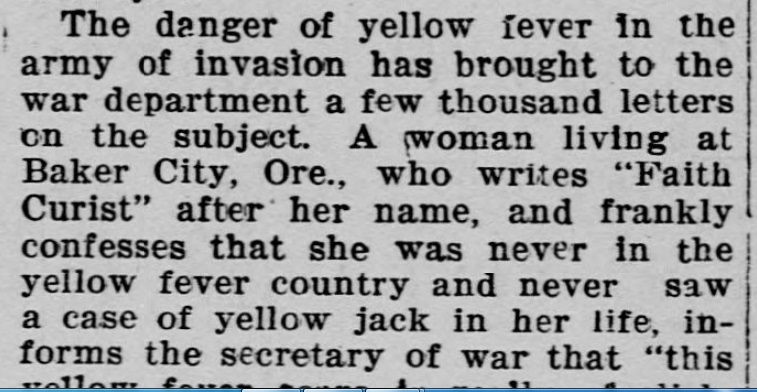
"How One Family Eluded the Yellow Jack"
Click Here to Read Article and See Reference

"Ideas - Stacks of Them" - Letters to the War Department
Click Here to Read Article and See Reference
\


Friday, May 1, 2020

Cure for Malaria - 1900


              **We do not endorse any ad for medical treatments.  Ads                    are placed for historical and anecdotal purposes only.  


Picture From:  Holbrook argus. (Holbrook, Ariz.), 13 Oct. 1900.
Chronicling America: Historic American Newspapers. Lib. of Congress.


Monday, April 27, 2020

Cholera - Pandemics - Early 1800s


"Ginger Brandy"
 Library of Congress Prints and Photographs Division
Washington, D.C. 20540 USA
 
//hdl.loc.gov/loc.pnp/cph.3b47948
In the 1800's, Cholera reared its ugly head in the States.  It was believed to arrive in New York harbor in 1832. It presented itself as watery diarrhea and vomiting, and was contracted by drinking contaminated water, milk, or by eating contaminated food. It spread throughout the United States via canals, railroads, and boats.

Cholera was often listed on death certificates as Choleric Fever, Cholera Morbus, or Dysentery.

Another ailment with these symptoms was called Cholera Infantum.  Several infants in the PMMP are listed as having died of it, but this was a different illness.  The term was used because the symptoms were similar to Cholera, but were not contagious.  The illness occurred between April and October, mainly to infants who had been weaned.  When proper refrigeration of food came about, less was seen of the illness.

This ailment was often listed as Cholera Infantus, Water Gripes, Summer Complaint, or Weaning Brash on death certificates.  

Read these two stories in Arizona newspapers:


Friday, April 3, 2020

Complexion and Constipation Corrector - 1894


>
Cures constipation and clears up your skin......hmmm.  


**We do not endorse any ad for medical treatments.  Ads are placed for historical and anecdotal purposes only.  


Picture from:  The Oasis. [volume] (Arizola, Ariz.), 14 June 1894.
Chronicling America: Historic American Newspapers. Lib. of Congress.
<https://chroniclingamerica.loc.gov/lccn/sn85032933/1894-06-14/ed-1/seq-7/