![]() |
| "Men's Fashion 1890's" Library of Congress Prints and Photographs Division Washington, D.C. |
Monday, May 25, 2020
Fashion of the 1890s
Friday, May 22, 2020
Lunice Teel (1883 - 1905) - Tragic Death
![]() |
| The Boston Store
Arizona republican. [volume] (Phoenix, Ariz.), 04 Nov. 1900.
Chronicling America: Historic American Newspapers
|
Lunice, nicknamed "Linnie", was born in McFall, Gentry County, Missouri, in April 1883 to Thomas Ross Teel and Rebecca Ann Graham. She was the second of eight children, of whom Chloe, Linnie, Elizabeth ("Lizzie") and Alfred were born in Missouri. Sometime between 1891 and 1893, the family moved to Phoenix where Edith, Mabel, Sadie and Ross Graham were born.
It's unclear whether this Teel family was related to the
Peter Teel family that migrated from Texas to Arizona in the
1870s, although census records show that some of
them had also been in Illinois and Missouri before settling
in Texas.
In Missouri, Thomas R. Teel's family had been farmers and
owned a flour mill. Later, in Arizona census records, Thomas was listed
as a farm laborer and his death certificate describes him
as a "miller".
Lunice E. Teel, just 3 months short of her 22nd
birthday, died of pneumonia on January 13, 1905, at her parents' home at
507 North 4th Street, Phoenix, Arizona. She was buried in
Rosedale Cemetery.
Linnie's obituary noted she was employed at the Boston
Store and that she was "an estimable young woman" and
"well-known and respected by a large circle of acquaintances". -
Story by Sue Wilcox
Wednesday, May 20, 2020
Saloma Newland (1838 - 1898) - Lady Prospector - Enterprising Women
![]() |
| Globe Mining District Library of Congress Prints and Photographs Division Washington, D.C. 20540 USA //hdl.loc.gov/loc.pnp/pan.6a17352 |
Saloma E. Larcombe Newland was a female prospector in
territorial Arizona. She was born around 1838 in Massachusetts. It
is unknown who her parents were, or if she had any siblings. Prior
to 1880, there are no census records that list her, and what has been
discovered comes mostly from newspaper articles.
She lived in Ohio at some point, as her daughter Flora
Larcombe was born on January 14th, 1859 in Steubenville, Ohio. Flora had
married Barry Baldwin in 1875 who was a United States Marshal for the Northern
District of California.
Saloma also lived in California on and off for several years
as Mrs. S.E. Larcombe, having married a Thomas B. Larcombe, a miner, at some
point. She divorced him in 1870. In 1864, she worked as a
sales agent in Virginia, Nevada Territory for the Florence sewing machine. In 1866, she worked as the manager of the Western Union Telegraph Office in
Santa Barbara, along with another job as operator at the Palace Hotel in San
Francisco. She left California in 1877, and
came to Arizona to pursue her interest in prospecting.
She would continue her mining endeavours in Globe while
managing a hotel in “Watsonville”, a mining camp near Ramboz peak. After marrying Thomas Newland in 1878, together, they mined several claims, which included
prospecting the Defiance, Pioneer, and Saloma Mines in the area of
Globe. In 1896, Thomas died of chronic pneumonia at 66
years of age. Saloma continued mining their prospects, earning her notoriety in the Arizona Republic, and an article written about her in the The
San Francisco Call in 1897 called “Arizona’s Lady Prospector”.
Saloma Larcombe Newland died of cancer December 31, 1898,
and is buried in Loosley. She has no headstone. For more information on her, come to the
Pioneer Military and Memorial Park to learn about this fascinating “lady
miner”.
Monday, May 18, 2020
Spanish Flu - Pandemics - Early 1900s
![]() |
| "Influenza Ward" Library of Congress Prints and Photographs Division Washington, D.C. 20540 USA //hdl.loc.gov/loc.pnp/cph.3a39569 |
There is no one in the PMMP listed as having died of the Spanish Flu. The cemetery had closed about four years prior to the outbreak. However, in reading this article it is interesting to note that the United States went through some similar events that we are now experiencing at this time.
![]() |
| Quarantine Lifted Click Here to Read Article and See Reference |
![]() |
| Mask Order Click Here to Read the Article and See the Reference |
Sunday, May 17, 2020
Pioneers' Cemetery Association Won Another Grant!
PCA is very excited to announce we were awarded a preservation grant from the National Society Daughters of the American Revolution. The grant was sponsored by Cactus Wren Chapter DAR of Chandler. The grant will allow for PCA to use the services of a conservator for the preservation of markers and the Loring Vault in our cemeteries. Thank you to Kandy Wagenbach, Gera King, W. Jobeth Fjell and Jenn Shaffer Merry for your help.
Friday, May 15, 2020
Feliciana Baker (1883 - 1884) - Tragic Death - A Short Life
![]() |
| Pioneers' Cemetery Association Archive |
On May 15, 1884, little Feliciana found a quantity of morphine pills, routinely prescribed at that time, and swallowed a fatal dose. The overdose was not discovered until she fell into a stupor, at which time a doctor was summoned. A galvanic battery was applied for three or four hours in hopes of reversing the effects of the drugs, but to no avail. Feliciana died at 7 AM the following morning.
Feliciana’s funeral took place that afternoon at the Catholic church. Hers was the very first burial in the newly opened Masons Cemetery.
Feliciana’s father, Albert Cornelius Baker, was a lawyer born in Crawford, Alabama on February 15, 1845. He enlisted as a color-bearer during the Civil War and was captured at the fall of Vicksburg. However, instead of sending the youth to a prisoner of war camp, his Union captors kept him to work as a bootblack.
Baker had intended to study for the Methodist ministry after the war; instead, he gravitated toward law and eventually went to San Diego and San Francisco to practice. Although he moved to Phoenix in 1879, he continued to visit friends in Yuma frequently and it was there that he met his future wife at the home of her father, Judge Henry Nash Alexander.
Baker’s law career included a two-year stint as a United States District Attorney, 1882-1884. In 1893, Baker was appointed Chief Justice of the Supreme Court of the territory of Arizona; he held that office for the next four years. In 1918, he was elected Justice of the Arizona Supreme Court. - from original story of Donna Carr
Come to the PMMP and visit Feliciana, and other "residents" at our park!
Wednesday, May 13, 2020
Mary A. Lee (1862 - 1900) - Restaurateur - Enterprising Women
This bio is present on one of our pages, but we thought we would highlight it here too. Mary's success was remarkable for her time, as women were not often seen in business roles.
Mary A. Lee was born about 1862, and was a restaurateur in Territorial Phoenix and Tucson during the late 1890s. She was a single, African-American woman who was reported in the December 5, 1897 Arizona Daily Star as "...the famous caterer who is known to prepare the finest dinner, breakfast, or luncheon in Arizona.." Not much is known about her early life, or where she was born. However, she appeared to have rose to the Phoenix scene around 1892 in a partnership she formed with Samuel W. Slade, called "Lee and Slade". The partnership maintained The Opera House cafe which featured "game, fish, and oysters". At the later part of the year, they acquired a five year lease for $18,000 from the owner of the Ford Hotel to maintain a restaurant on the premises. The partnership dissolved in 1896, and Mary ventured to Tucson where she became of the proprietor of Williams Hotel, The Alhambra, and the Orndorff Cafe. Mary returned to Phoenix suffering from an illness, and died of tuberculosis October 26, 1900. Curiously, her probate records states that she had an account at the National Bank of Arizona at Tucson for $325 and a trunk of personal effects in Phoenix. Her executor later stated that these items "could not be found." She is buried in Rosedale with no marker.
![]() |
| The border vidette. (Nogales, Ariz.), 18 Feb. 1899. Chronicling America: Historic American Newspapers Library of Congress https://chroniclingamerica.loc.gov/lccn/sn96060796/1899-02-18/ed-1/seq-4/> |
The Mary's Cafe Fare menu is dedicated to her. It consists of breakfasts, lunches, and dinners found often in the home and restaurants of the 1890s, and consists of three planned meals with recipes. The recipes are found from cookbooks of the era that are posted on Project Gutenberg. References available on request. The menu is written and designed by Val Wilson.
Monday, May 11, 2020
Influenza - Pandemics - 1800's
![]() |
| "Hard Case" Library of Congress Prints and Photographs Division Washington, D.C. 20540 USA https://hdl.loc.gov/loc.pnp/ppmsca.45308 |
It transferred to America by transatlantic travel, and then was transmitted by our transportation infrastructure throughout the states.
It was called "Asiatic flu" or "Russian flu", and later determined that the strain was Influenza A, subtype H3N8.
On an interesting sidenote, an H3 antigen influenza did re-occur in 1968 as H3N2. It was called the "Hong Kong flu", and arrived in the United States. Tests on the very elderly during this time demonstrated that the majority had H3 antibodies from exposure to H3 viruses circulating in 1891. This age group remained relatively well protected during the 1968 pandemic. This type of study is called "sero-archaeology".
Old death certificates may list the late 1800's influenza pandemic as Grippe, La grippe, or Influenza.
We have at least 13 people in the PMMP who died from influenza during this time period. In some cases, cause of death may have been identified as something else that may have been related to influenza, such as pneumonia, etc.
![]() |
| La Grippe Click Here to Read the Article and See the Reference |
Friday, May 8, 2020
A Popular House Plan - 1898
![]() |
| A Popular House Plan Click Here to Read the Article and See the Reference |
All for $2,000, minus mantles........
Wednesday, May 6, 2020
Emma McGehon (1862 - 1903) - Stage Coach Station Owner - Enterprising Women
![]() |
| Emma McGehon Archives of Pioneer Cemetery Association |
Emma was born around 1862 in Santa Cruz, California, to Causten
Van Rensler Beauchamp and Sarah Elizabeth Hinton, who were originally from Virginia. It should be noted that the name‘Beauchamp’ is
usually rendered as ‘Beechum’ in early documents, since that’s how it’s
pronounced. The Beauchamp family moved to Phoenix from Santa Cruz, California,
around 1878.
They managed the Swilling Hotel. Later, they operated the stage station on the Black
Canyon Road near where it was crossed by the Arizona Canal. As her parents
aged, Emma took over more of the management on the stage station. She cooked for
the stage passengers and provided a few amenities to women travelers. She
married William McGehon, a stage driver, in Phoenix in 1881. They had two sons, one of which is buried next to Emma in City/Loosley, where she was laid to rest in Section B10, Lot 2, Grave
9. Come visit Emma at the Pioneer Military and Memorial Park, and learn more about stage coaches, and the wild west!
![]() |
| Emma's stage coach stop would have been somewhere around here. |
Monday, May 4, 2020
Yellow Fever - Pandemics - 1800s
![]() |
| "Fleeing from Yellow Fever" Library of Congress Prints and Photographs Division Washington, D.C. 20540 USA //hdl.loc.gov/loc.pnp/ds.13083 |
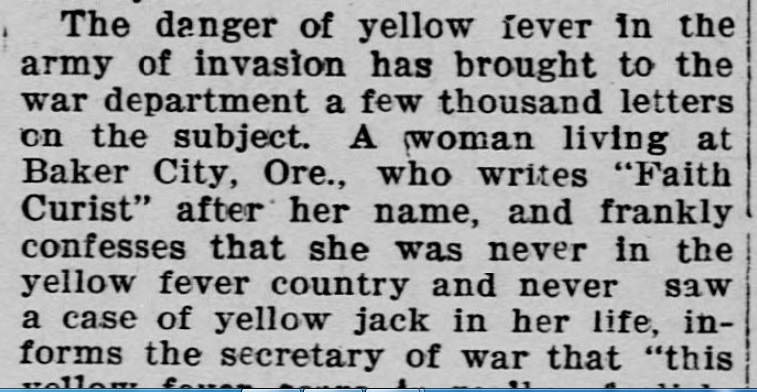
Yellow fever was a flu-like illness that was later discovered to be spread by mosquitoes. It was characterized by high fever, aches, chills, and jaundice, which is why it was called "yellow" fever. Yellow fever spread throughout the United States during the 18th and 19th century. Cities with primary ports suffered greatly, as the fever arrived from Africa. It also spread down the Mississippi River. Boston, New Orleans, Savannah, and Memphis were stricken down with the illness, and the disease caused wide spread panic and disruption.
The PMMP has no known burials due to Yellow Fever. However, it is possible that someone did die of the illness, and the obituary or death certificate listed it as something else.
Old death certificates can list it as Bronze John, American Plague, Dock Fever, Stranger's Fever, or Yellow Jack or Jacket.
![]() |
| "How One Family Eluded the Yellow Jack" Click Here to Read Article and See Reference |
![]() |
| "Ideas - Stacks of Them" - Letters to the War Department Click Here to Read Article and See Reference
\
|
Friday, May 1, 2020
Cure for Malaria - 1900
Wednesday, April 29, 2020
Ong Sing Yuen (1913) - Renaissance Men
![]() |
| Arizona Vital Records - Genealogy - Death Certificate |
They worked in small, family-run businesses such as restaurants, grocery stores, hand laundries and vegetable farms. Although many of Phoenix's early Chinese residents eventually returned to China, about fifty were buried in the Pioneer & Military Memorial Park.
In 1993, archaeologist K. J. Schroeder asked William Tang, an associate professor at Arizona State University, to translate the inscription on the marble headstone in Loosley. Tang, a Mandarin speaker from northern China, translated it as that of Tang Xian Yuan, born in Canton province, Hoiping district, Da Lou village.
Years later, PCA researchers discovered the death certificate of Ong Sing Yuen, aged about 51, who died 8 June 1913 and was buried in Loosley. Since the man buried in Loosley had been born in province, he would almost certainly have been a speaker of Cantonese, and 'Ong Sing Yuen' is in fact the Cantonese equivalent of the Mandarin 'Tang Xian Yuan'. - Adapted from a story by Donna Carr
Ong was a merchant living at 529 S. 7th Avenue, and there are many more things to know about him.
If you would like to learn more about Ong, visit the Chinese Pioneer Memorial and us at our Pioneer Military and Memorial Park library!
Subscribe to:
Posts (Atom)